
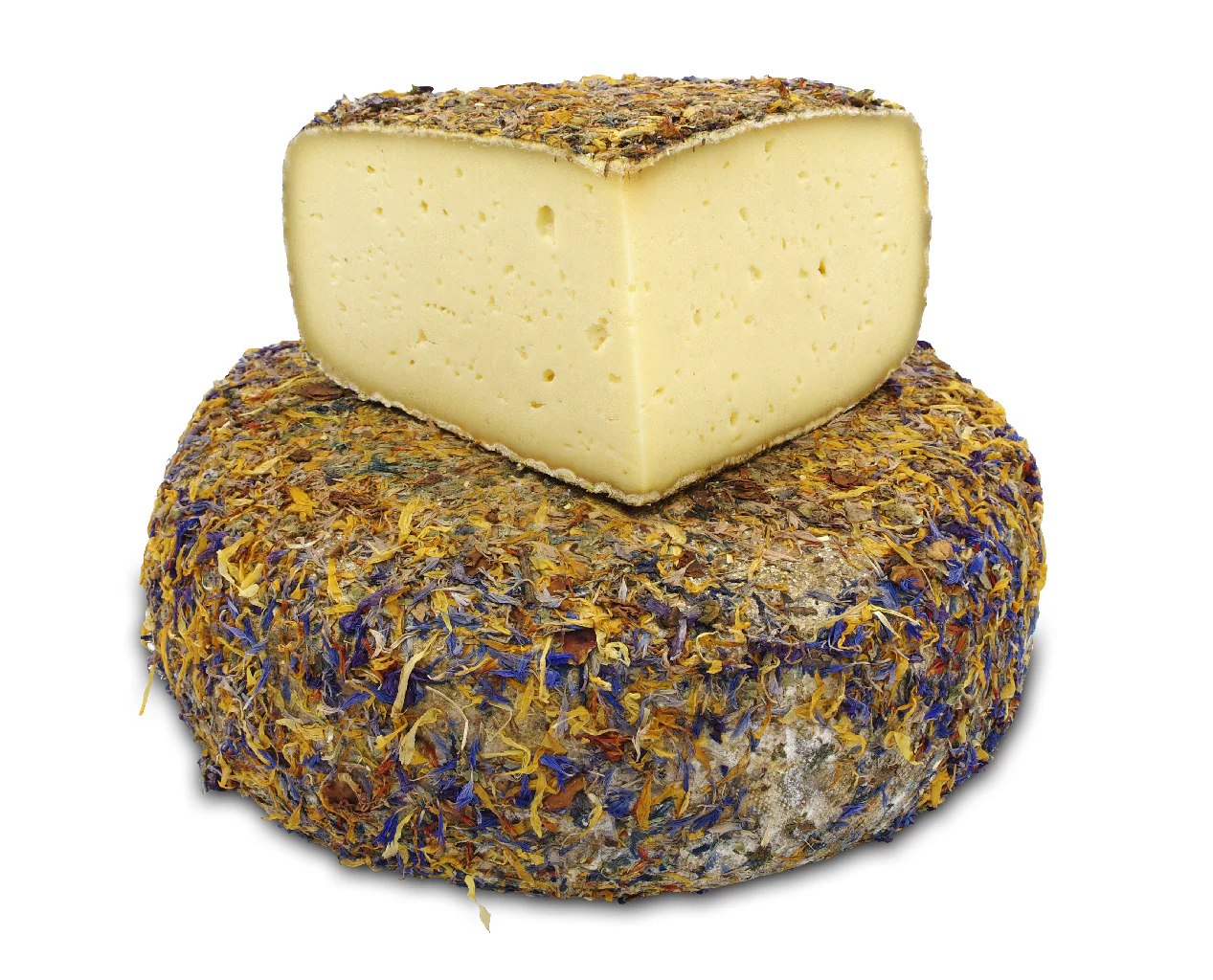
Tomme aux 7 fleurs
The Tomme aux 7 fleurs is a thermised cow's milk cheese.Its rind is covered with 7 different flower petals: mallow fowers, marigold flowers, blueberry flowers, safflowers flowers, rose blossoms, strawberry leaves and trigonella, which give the cheese floral and nutty flavours.
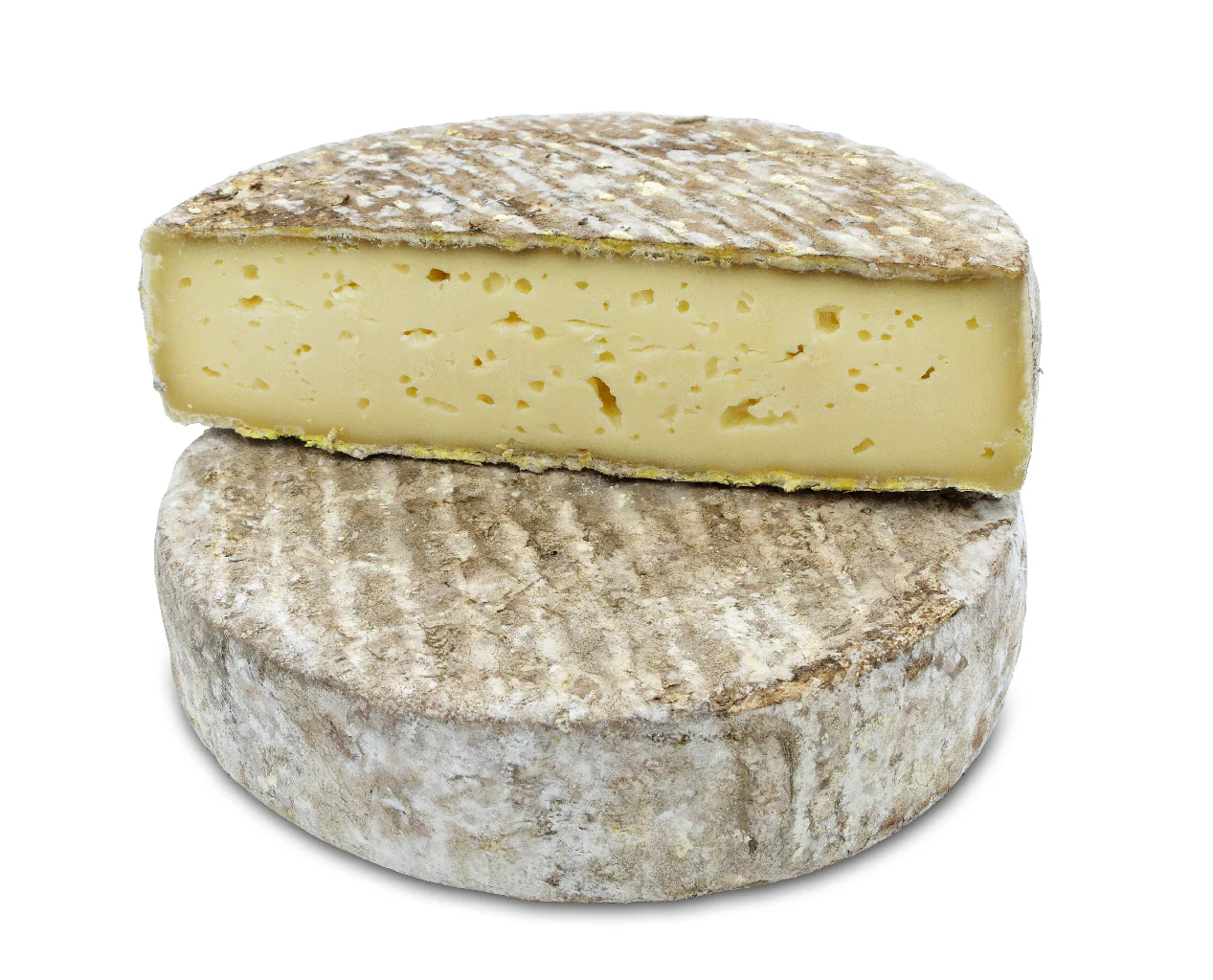
Tomme de Montagne
The Tomme de Montagne(Unpasterised Milk) is made in Désaignes, in the Monts d'Ardèche Regional Natural Park, from mountain milk collected from farms located no further than 20-km from the cheese dairy. It is then matured for 2 months in our maturation cellar in Savoie. It has a soft straw yellow paste, dotted with a multitude of holes like the Tomme de Savoie. It has a nice fresh pasture grass aroma and balanced earthy and fruity notes with pleasant fresh milk notes.
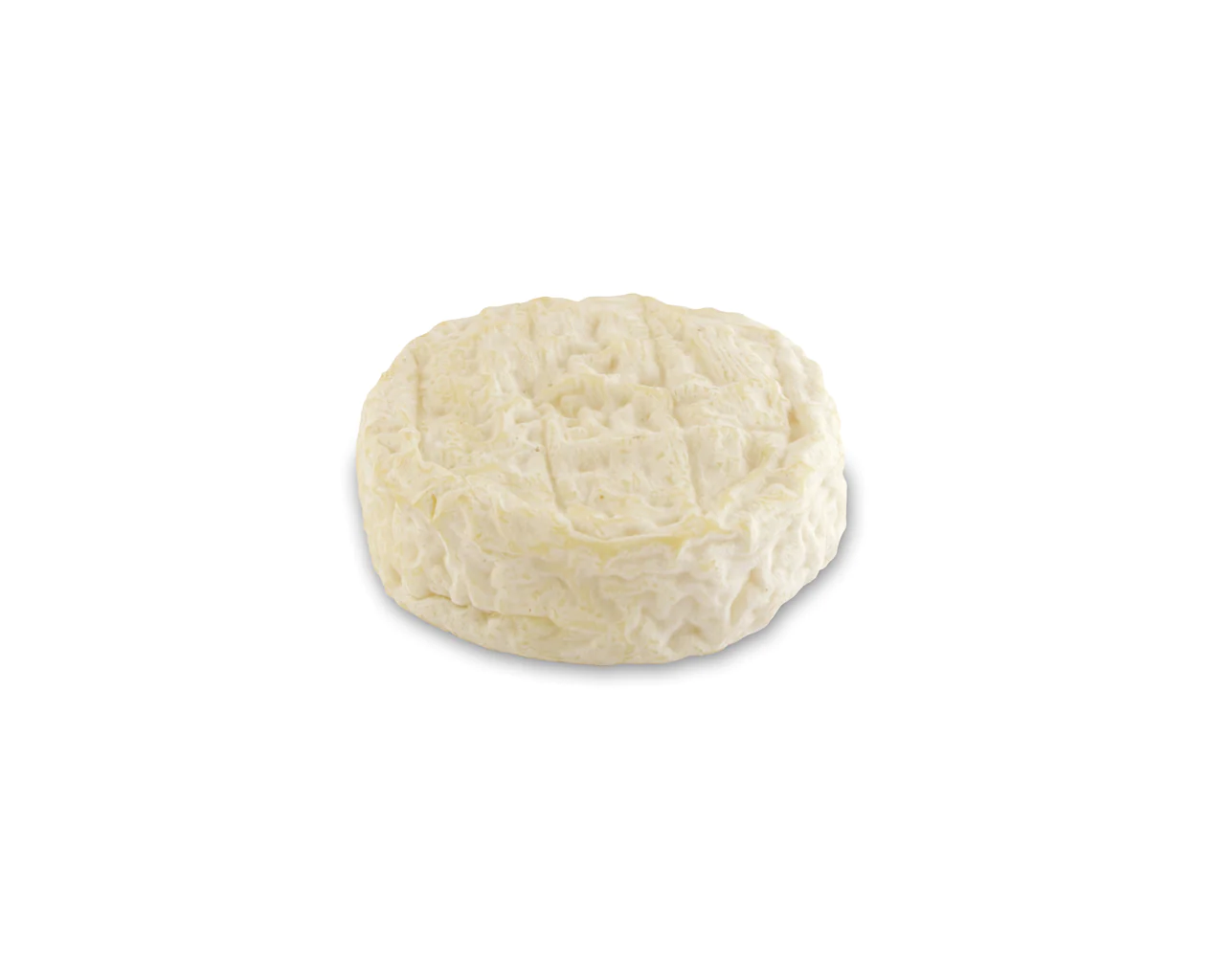
Saint-Marcellin
Like its larger counterpart, the Saint-Félicien, the Saint-Marcellin( unpasteurised cow's milk) is a young, creamy cow’s milk cheese from Dauphiné region. Beneath the delicate bloomy rind, there is a glossy white cheese with a meltingly-soft texture and creamy, slightly tangy and savoury flavours. It is both simple and delicious.
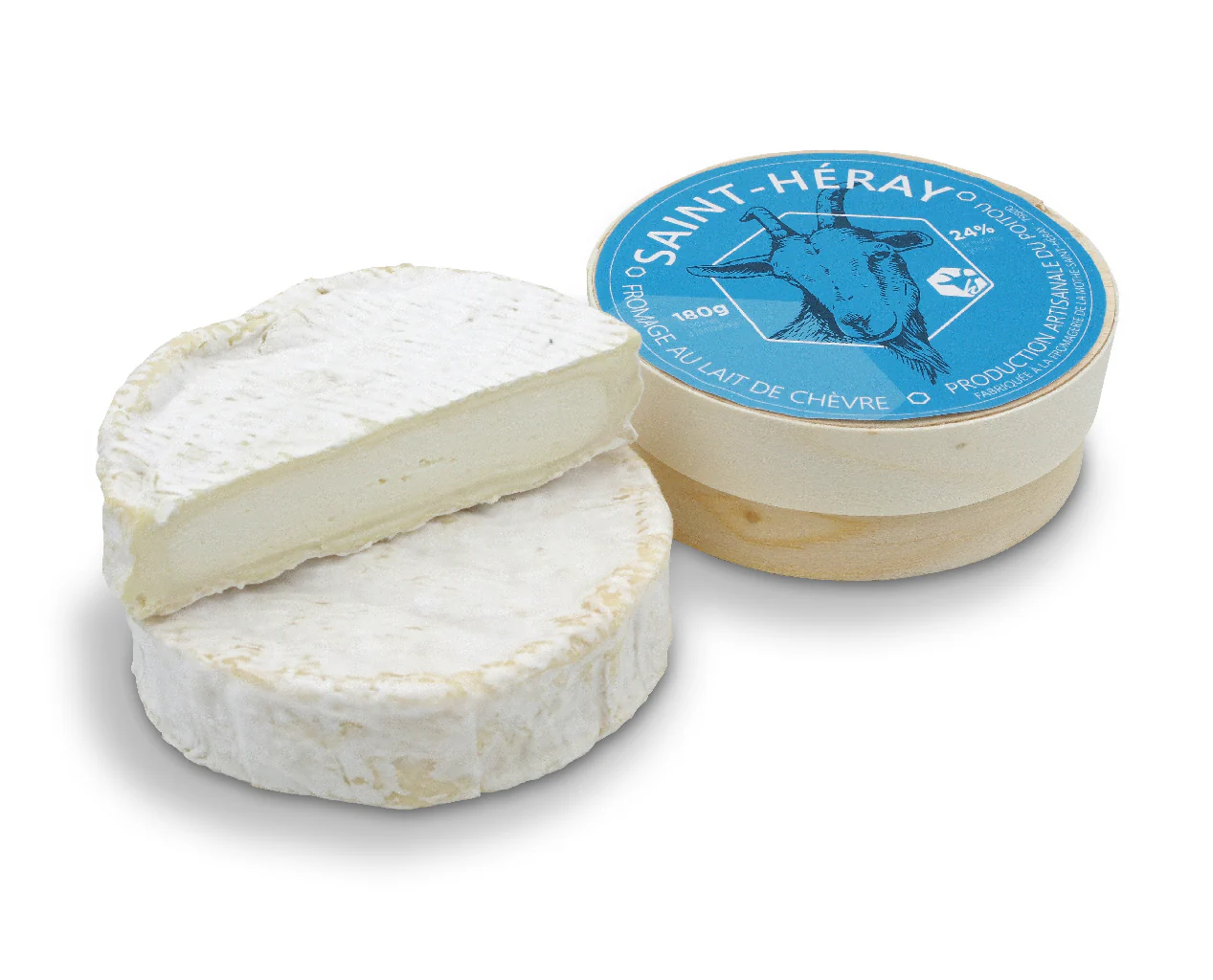
Saint-Héray
In 1906, pastor Eynard started to make goat's milk bloomy rind cheese in la Mothe-Saint-Héray village (Deux-Sèvres). The Saint-Heray is a "chèvre-boite" with a creamy texture and tangy notes.
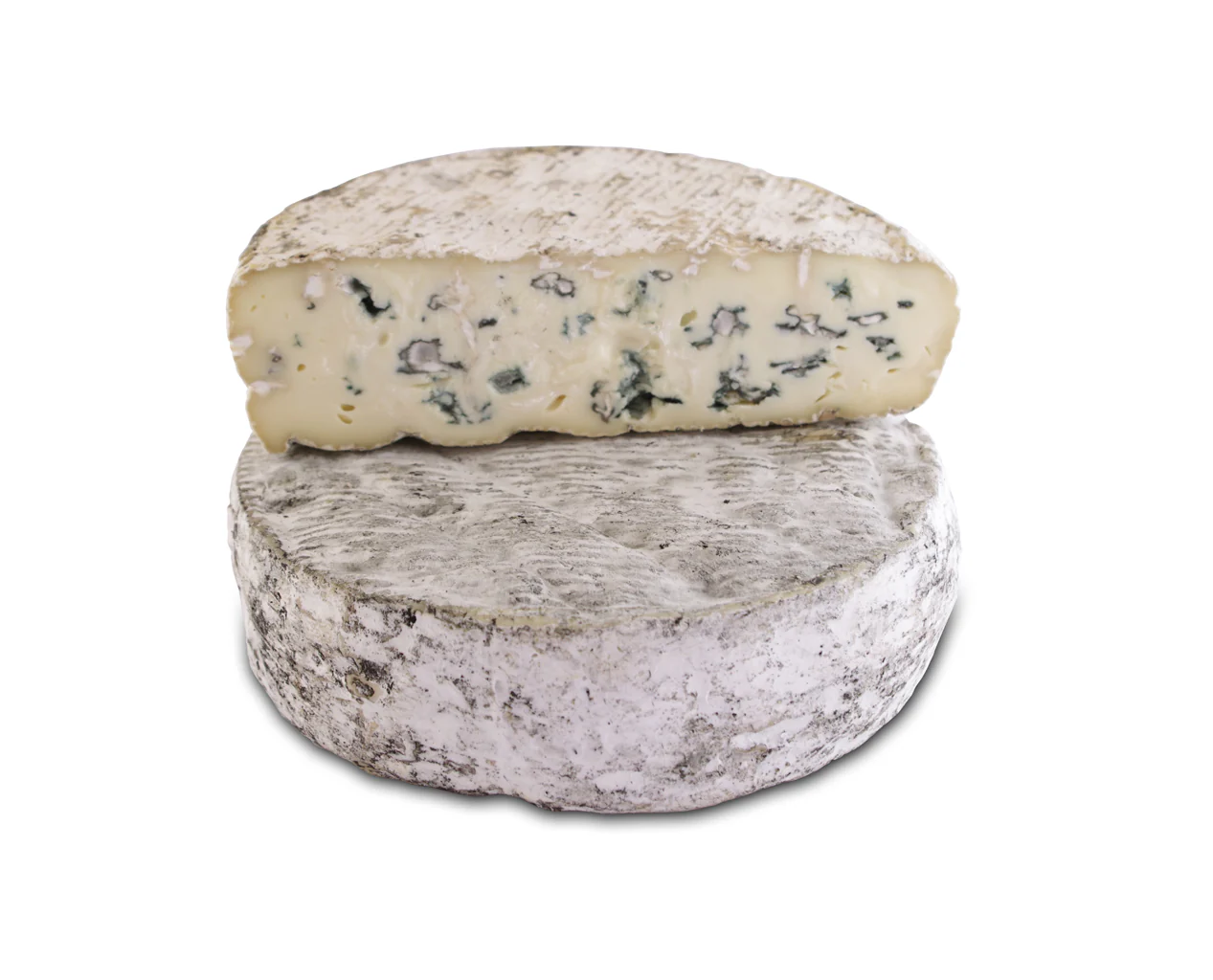
Roche Montagne
Made in the Puy-de-Dôme, the Roche Montagne is a cheese with the crust is ashed at the end of refining. Its dough is similar to that of a Reblochon, supple and smooth with a light persillage. It is a blue cheese which has a delicate taste.
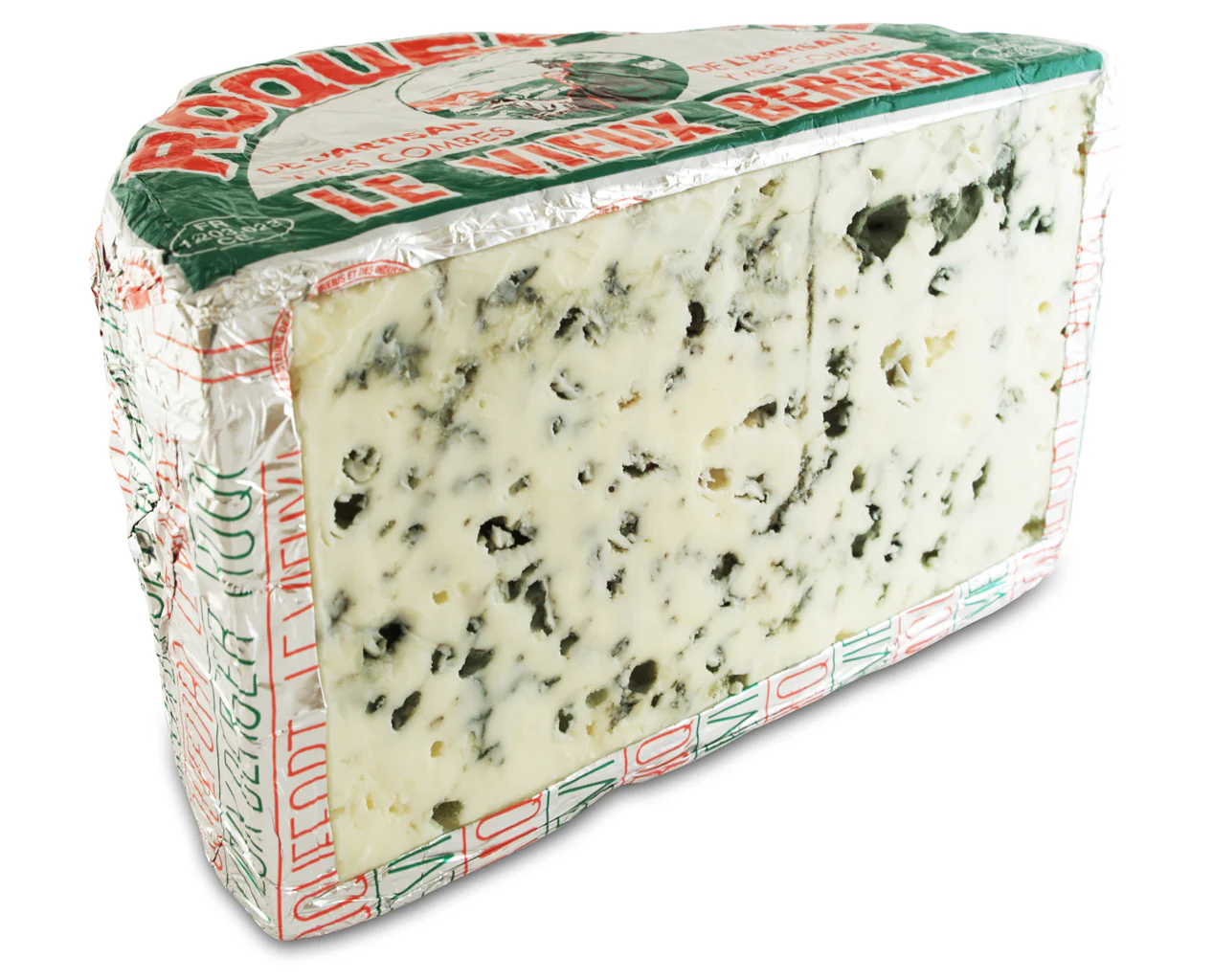
Roquefort d'Artisan Berger
The Roquefort d'Artisan Berger(Unpasterised) is one of the last hand-made Roquefort cheese in France, where the exceptional quality of Lacaune ewes’ milk is transformed into a complex and powerful cheese. The penicillium roqueforti is added to the milk before curdling, and the curds are cut and moulded by hand. The fresh cheese is left to drain for 3 days during which is turned 3 times a day, and then it is sent to the cellar to mature on oak shelves. The contact of the air with the holes throughout the cheese allows the penicillium to develop the blue green mould. It has no rind and a crumbly, moist and buttery texture with blue green veins throughout. Its full, sharp and long-lasting flavours make it an outstanding cheese worthy of being called the “cheese of kings and popes”!
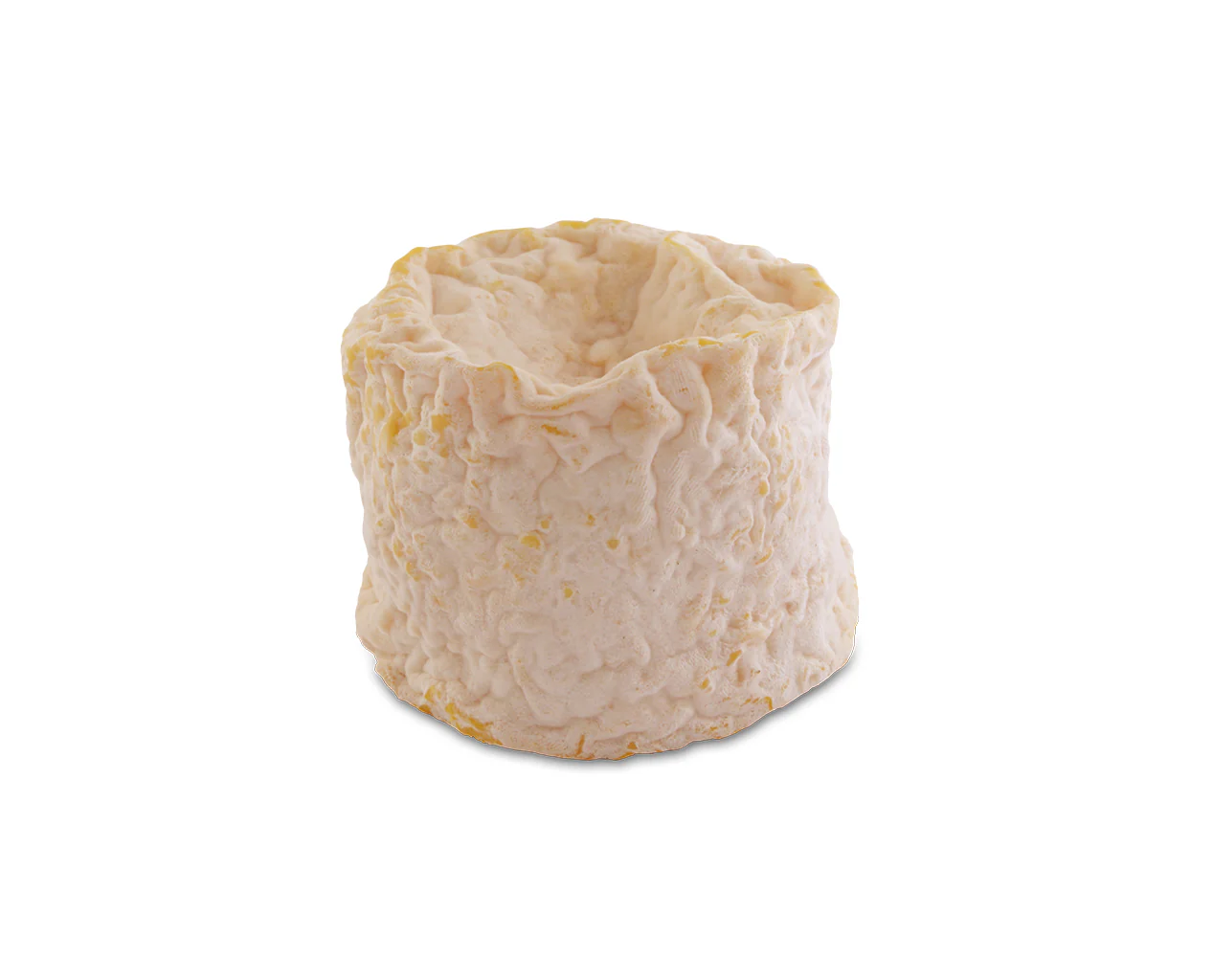
Petit Langres
Its shape has everything to astonish: at its summit, a basin called fountain is the result of its ripening process during which Langres knows only two turns. Like L'Epoisse, Langres is draped with a bright orange crust due to regular washing with salt water. At the cut, its white ivory paste has a real suppleness, even a creamy texture that has everything to please.
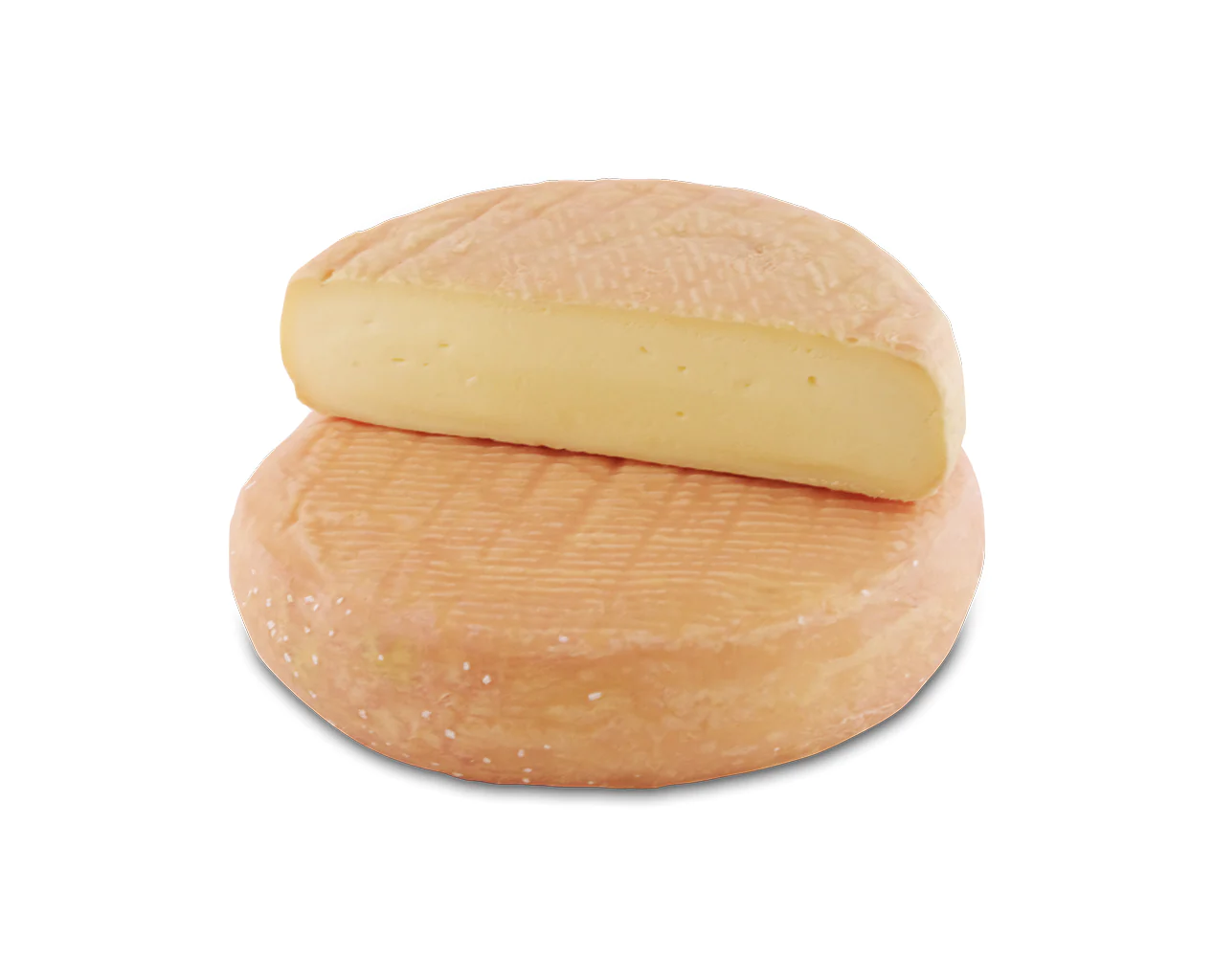
Munster fermier
Two generations of the Claudepierre family have been making cheese for over 20 years on their farm in a natural park in the Vosges Mountains. It is here where Munster Fermier is made from the rich and buttery milk collected from their cattle, which enjoy the wildflower-rich pasture in spring and summer and are fed with local hay in winter.. The cheese is then matured in their humid cave and washed with brine to develop a thin, sticky pale orange-yellow rind housing a soft and creamy paste.
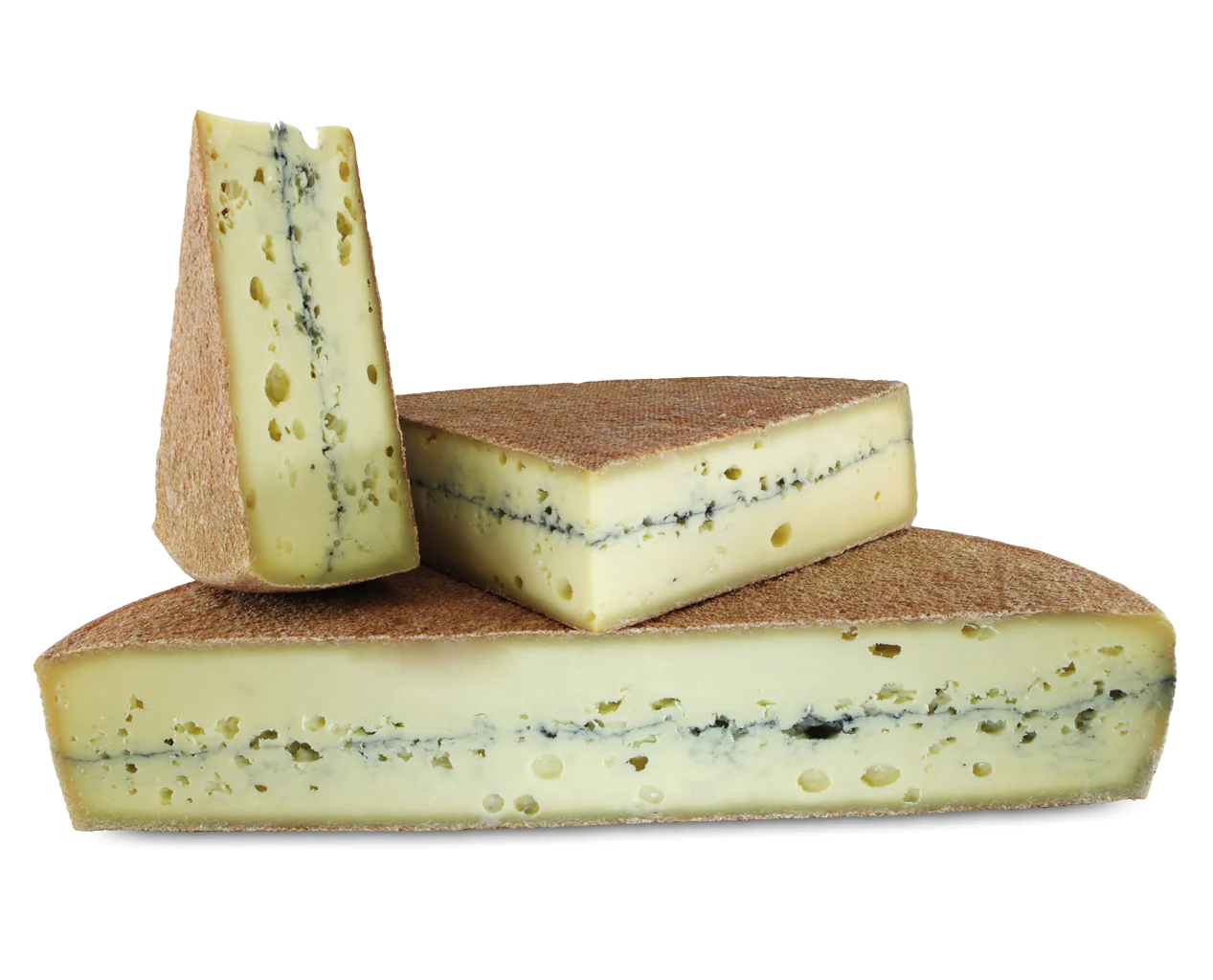
Morbier
The history of Morbier is linked to that of the Comté cheese. It is thought that farmers used the leftover curd from the production of Comté, which was not enough for a whole wheel, to make a cheese they would keep for their own consumption. They would cover the top of the curd with ashes to protect it, then add a second layer from the leftovers of the next Comté production day. Nowadays, farmers make the Morbier wheel from a single milking, but they have kept the distinctive dark line that runs through it.

Fourme d'ambert
One of France’s oldest cheeses dating from as far back as the Roman times, the Fourme is also one of the most popular. Having a PDO designation since 1970s, it is a creamy and delicate blue cheese that will please connoisseurs and beginners alike. The Fourme d'Ambert is made from pasteurised milk and is the most delicate of the blue cheeses. Its flavours are remarkably balanced, the buttery smoothness of cow’s milk contrasting with the sharper and nuttier blue.
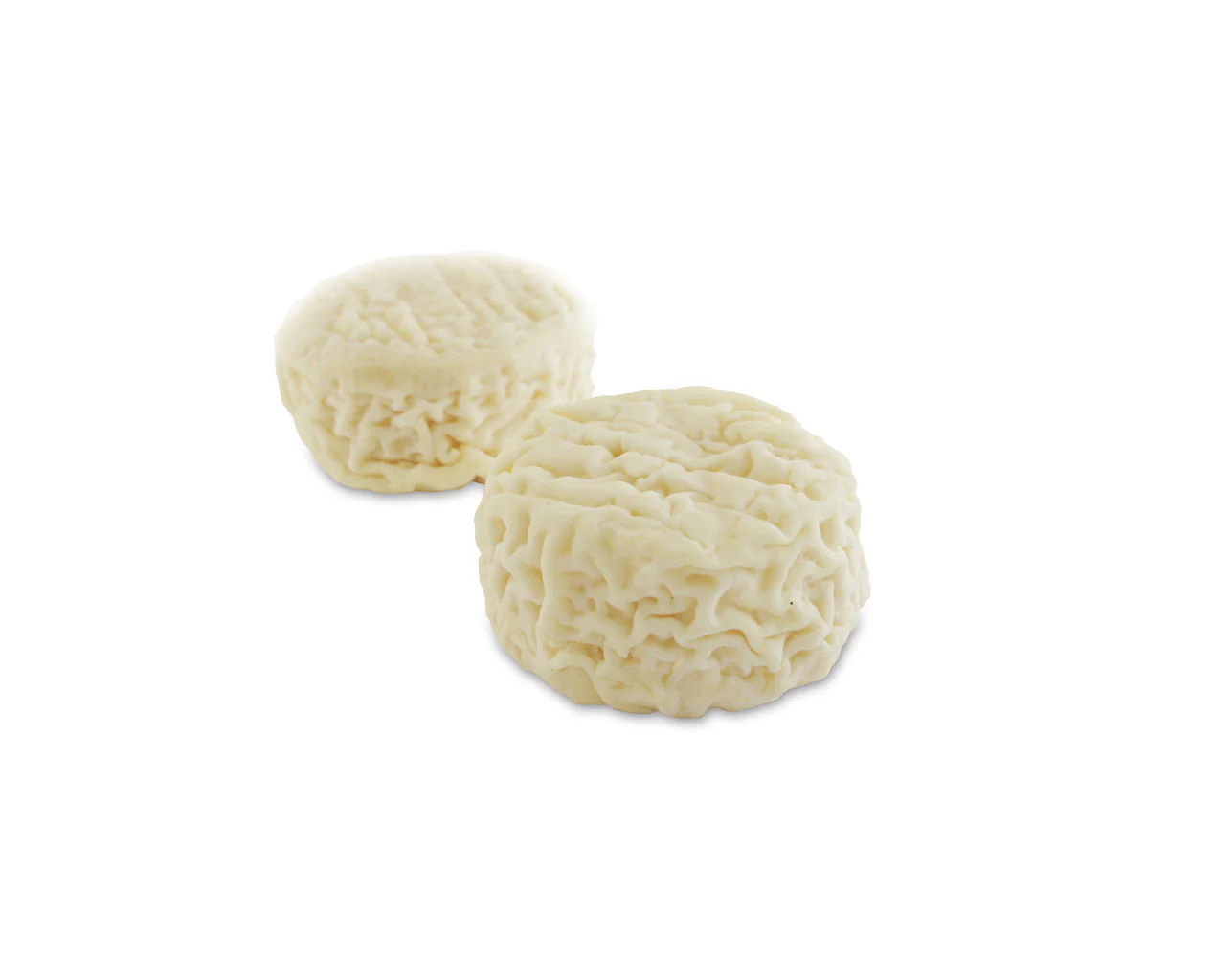
Crottin de pays
The Crottin de Pays is a goat cheese made from thermised milk in our Fontenille workshop. The texture is both crumbly and melting in the mouth. The cheese has a fresh and delicate "goaty" taste. It can either be enjoyed with a slice of fresh bread and butter or cooked.

Comté 6/12/24 months
The Comté is an artisan cheese that has a PDO designation since 1952. It takes about 450 litres of milk to make just one wheel of Comté. Farmers let their cattle graze on mountain pastures in summer, and feed them with hay in winter. It is the art of affinage though that makes the Comté a truly great cheese. When maturating on boards of spruce in humid caves, it develops a thick rind, which becomes crumblier and darker during ageing. Our affineur, Jean Lecatelli (Vieu d'Izenave) carefully checks and turns the wheels, tapping them to check for cracks. A nice ripened Comté has a smooth yellow pâte with a buttery texture. Its flavours become more complex and long lasting throughout the year, developing the sweetness of dried fruits and hints of nuts perfectly balanced by savoury notes.
Camembert
The most famous French cheese! Its flowery crust is white duvet. The paste is ivory to light yellow in colour, revealing local flavours, a powerful bouquet accompanied by a small salty tip when it is ripened. Magic!
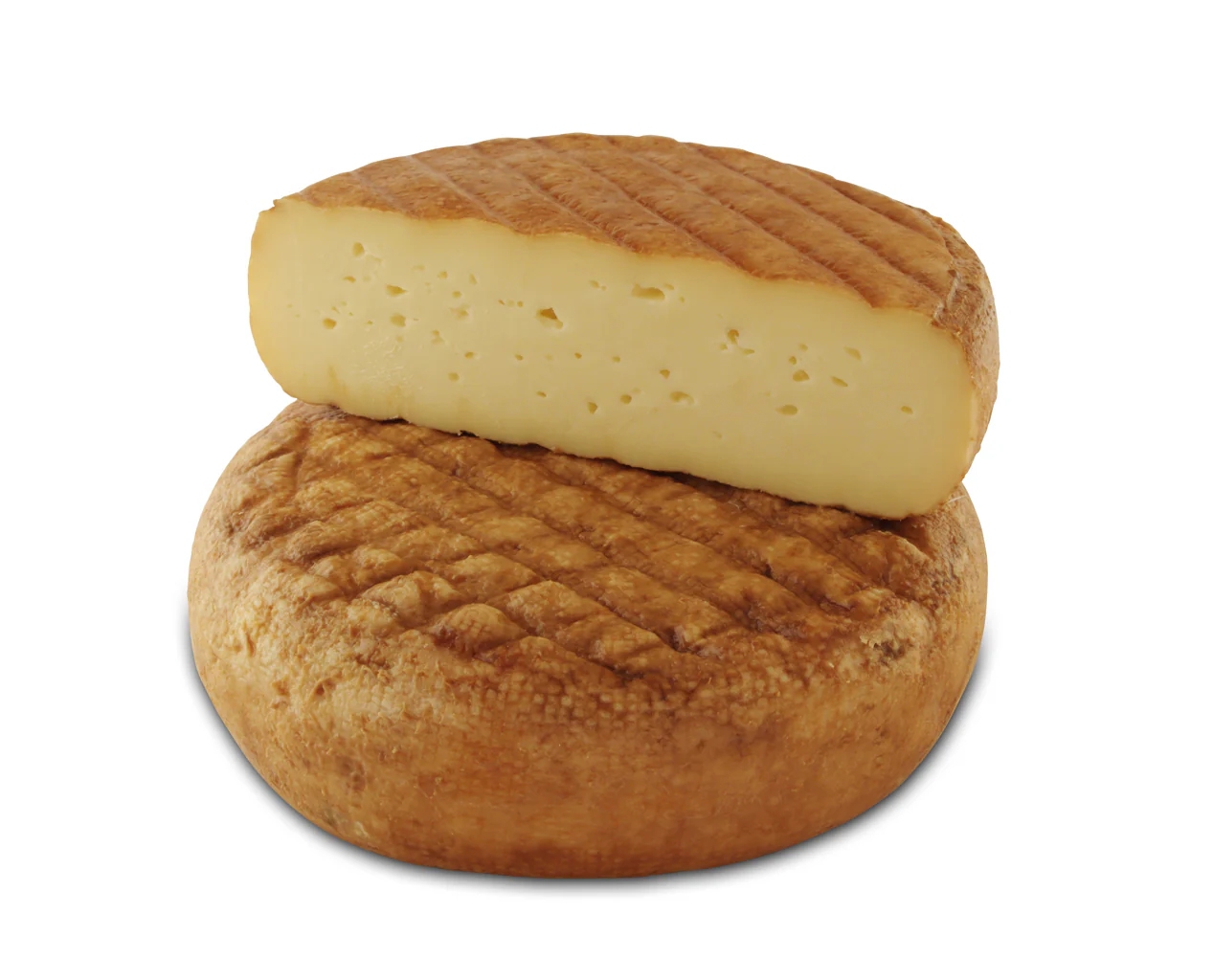
Brun de noix
The Brun de Noix is produced in our dairy in Machecoul, in the countryside, to the south of the Loire River. It is made from raw milk, brushed regularly with a walnut liqueur and kept in a moist cave for up to 2 months. Taking its striking colour from the walnut, it has a pretty shape that enchants the eye and an appealing aroma that tickles the nose. The pale yellow cheese underneath has a soft delicate texture. Its flavours strike a perfect balance between the fresh milky taste of the cheese and the powerful nutty notes of the rind. A unique and surprising cheese that cannot be missed!
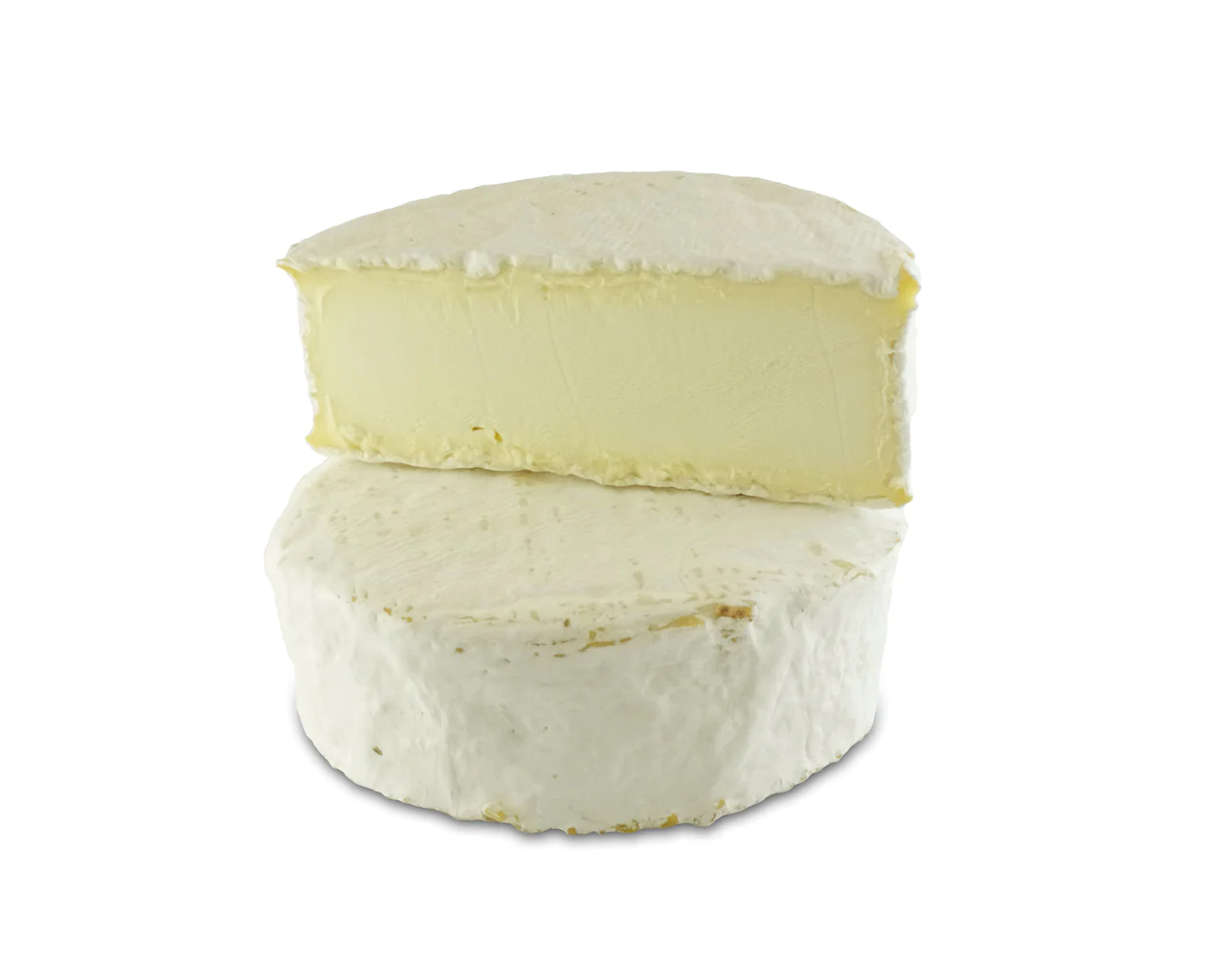
Brillat-Savarin
Created as an homage to the eponymous gastronome, the Brillat-Savarin aims to please! A triple-cream cheese with an irresistible luscious, melting-in-the-mouth texture. Its flavours are quite delicate. The cheese is made of triple cream and matured for only a couple of weeks, so that the delicate milky and creamy flavours stand out. But as it matures, it becomes more savoury, getting a hint of mushroom. Our Brillat Savarin was rewarded with a silver medal this year at Le Salon de l'Agriculture in Paris.
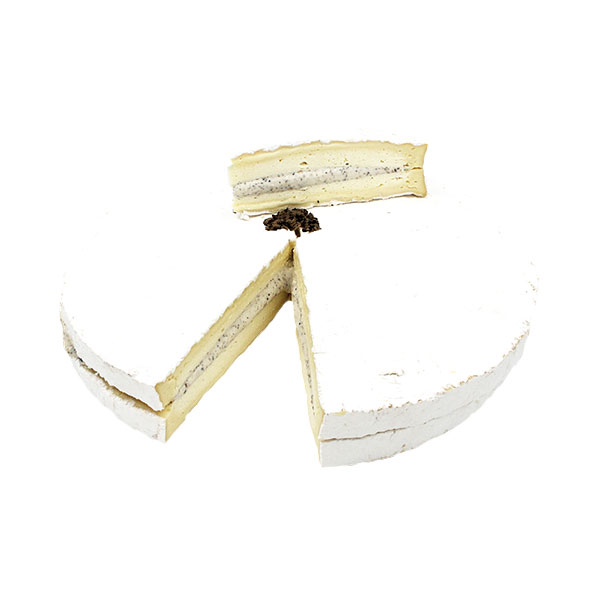
Grand Morin with Truffle
one of those cheeses that combine flavors wonderfully. First of all, the cheese itself is made in our workshop in Bries-de-Saint-Remy. It is a product with a flowery rind with a slightly nutty taste designed to perfectly accompany truffles. Let’s talk about truffles in ! This is a summer truffle selected to be eaten raw. Its surprising taste offers an irresistible marriage with a soft cheese like our Grand Morin. Ideal for parties, it is known among cheesemakers for offering above all excellent value for money. It therefore combines all the good reasons to have fun!
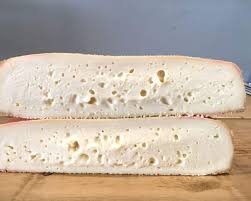
Maroilles
Maroilles, also known as Marolles, is a cheese made from cow's milk, believed to have originated in AD 962 by a monk in the northern part of France. It is named after the village of Maroilles, where it continues to be produced.
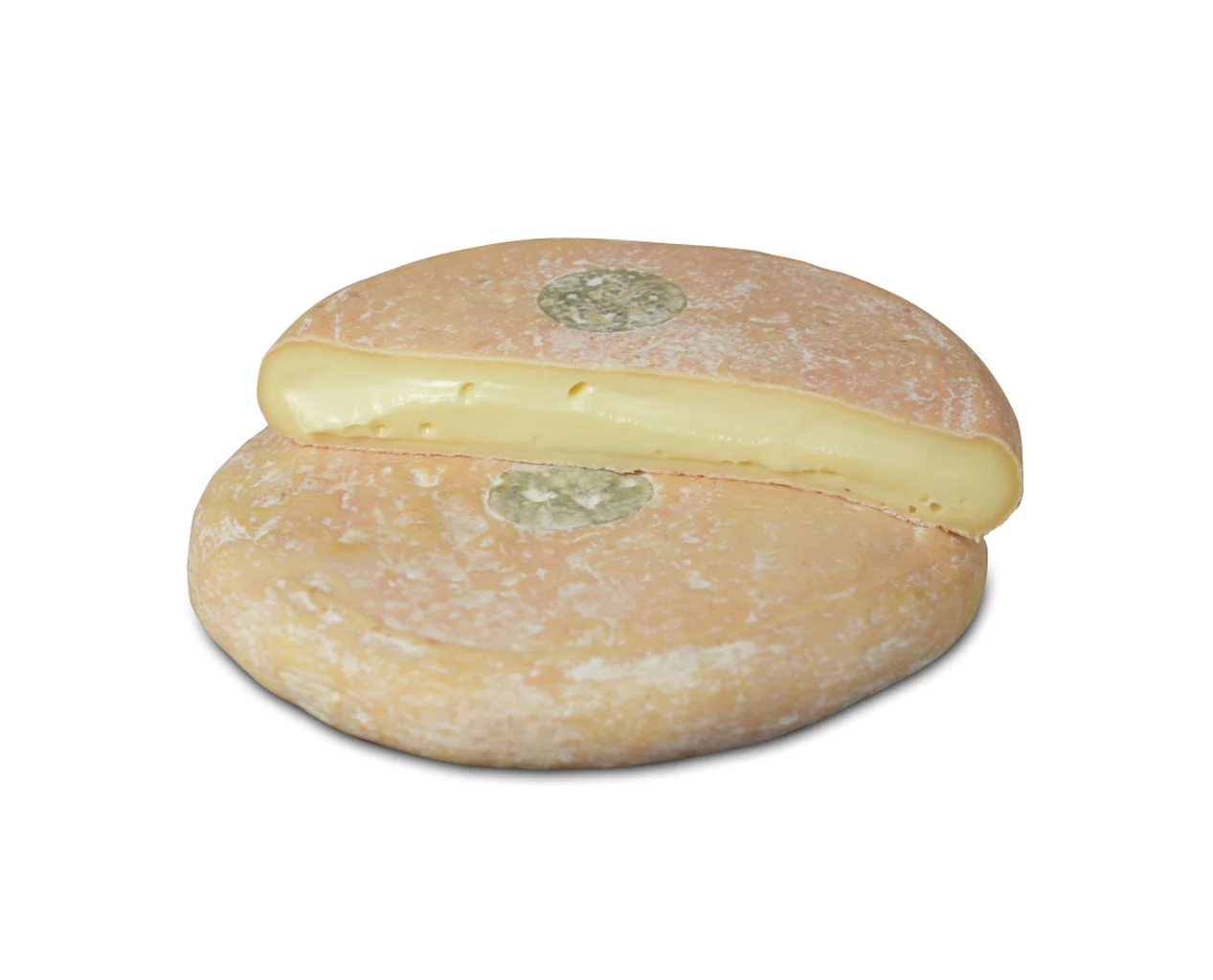
Reblochon fermier
In Haute-Savoie, in the heart of the French Alps, the Montbeliard, Abondance and Tarentaise cattle graze by the chalets. Being granted PDO protection in 1952, it is the only area where the Reblochon can be produced. Between June and October, the animals are kept outdoors on the green pastures, where generous amounts of rain and snow over the winter keep the grass exceptionally rich. This means that in spring and summer, our Reblochon has a particularly creamy texture. Matured for 4 to 5 weeks, it develops a straw-coloured rind and pink hues during maturation.
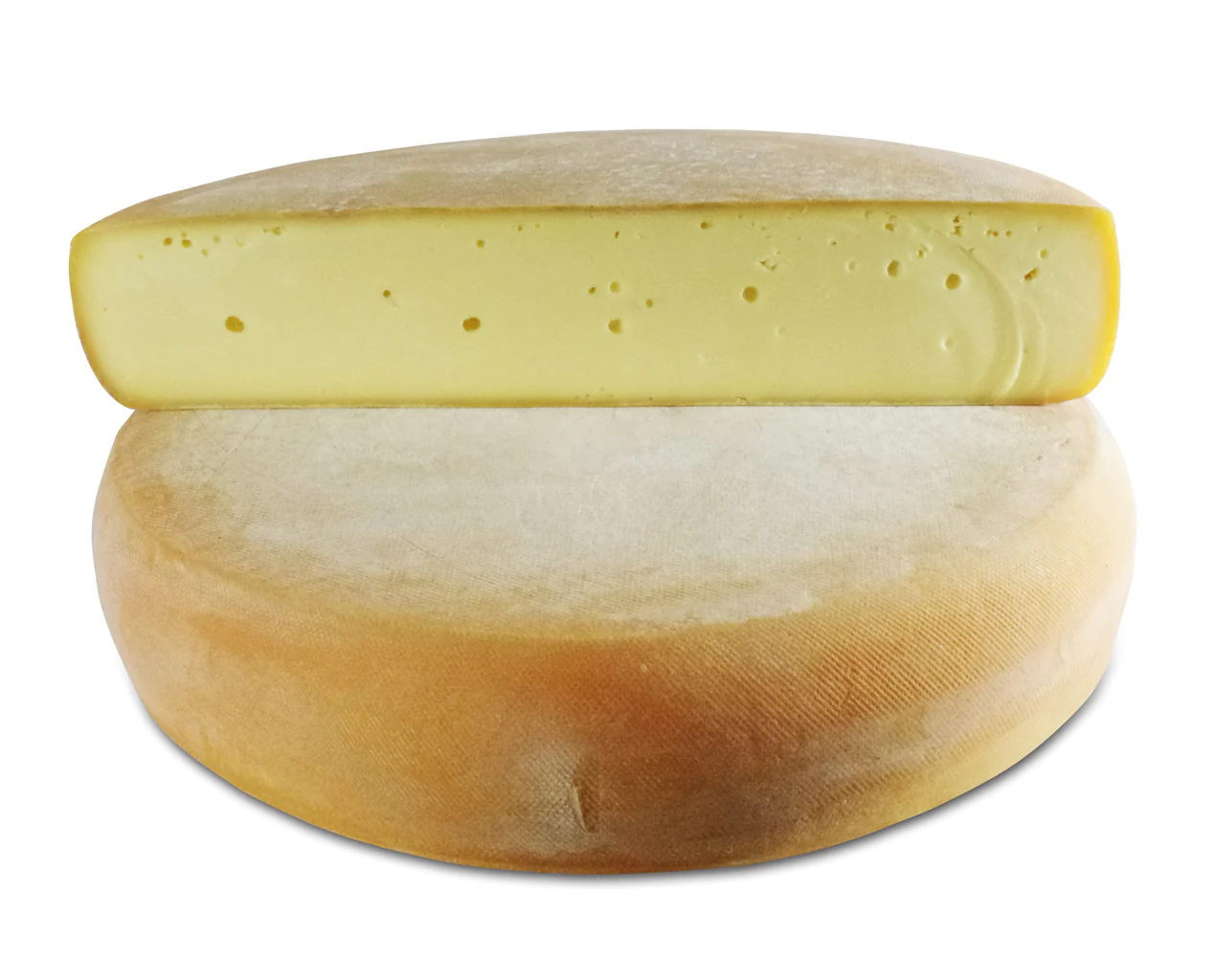
Raclette de Savoie
Produced in La Savoyarde, nestled in the Savoie Mountains, our Raclette is made from the thermised cow’s milk collected from the neighbouring farms. It is matured on spruce for at least 8 weeks. The wood gives the cheese a nuttier flavour, and it helps regulate the moisture of the rind. Although perfectly enjoyable when eaten cold, the Raclette cheese truly reveals itself when melted as part of the famous eponymous dish: “Raclette”. It is a traditional Swiss meal cooked by heating the cheese either in front of a fire or by a special machine and scraping (“racler” in French, giving the name raclette) the melted cheese onto potatoes and cured meats. A simple and perfect meal to be shared with family and friends!
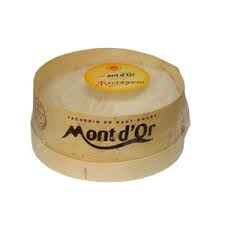
Vacherin Mont d'Or
Vacherin Mont d'Or, or simply Vacherin, is a cow's milk cheese. Two main types of French or Swiss Vacherin cheeses exist. One type of Vacherin cheese is called mont d'Or, or Vacherin du Haut-Doubs, from France, or Vacherin Mont-d'Or from Switzerland.